Appellate Division Modifies the $77 Million Richmond Capital Judgment: What Survived and What Came Off
Last reviewed: September 2026
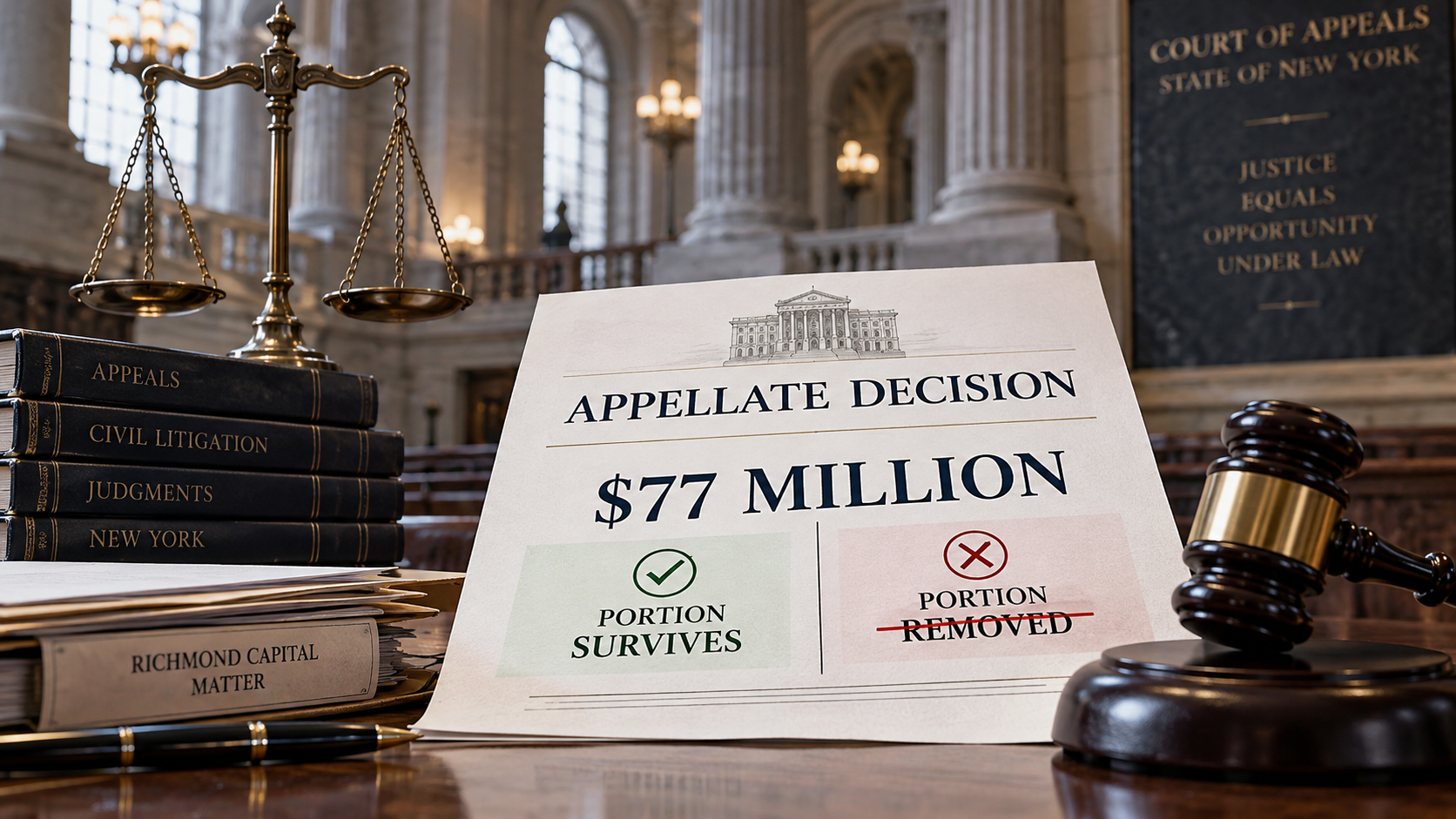
On February 19, 2026, the Appellate Division, First Department, unanimously modified the judgment in People v Richmond Capital Group LLC, 2026 NY Slip Op 00990. The court vacated the monetary portion of a $77,289,631 judgment, sent the damages question back to the trial court, and affirmed everything else.
That last clause is the part most coverage skipped. The funders did not win. Every liability finding the New York Attorney General obtained — usury, fraud, unconscionability, personal and joint-and-several liability — was left standing. What the First Department took issue with was arithmetic, not culpability.
For business owners who still hold paper written by Richmond Capital Group, Ram Capital Funding or Viceroy Capital Funding, and for anyone litigating a merchant cash advance lawsuit against a different funder, the decision is worth reading closely. It is one of the most detailed appellate treatments of how a New York court decides whether an advance is a purchase or a loan — and it is also a lesson in how a regulator can prove liability and still lose its damages number.
What the Court Actually Did
The case is a special proceeding brought by the Attorney General under Executive Law § 63(12), the statute that lets the AG sue over repeated or persistent fraud or illegality in the conduct of business. The People alleged that the respondents funded more than 3,000 transactions styled as merchant cash advances that were in substance fraudulent, usurious loans.
Justice Andrew Borrok of the Commercial Division granted the AG summary determination in September 2023 and entered judgment on April 11, 2024 for $77,289,631 plus interest, jointly and severally. The respondents appealed.
The First Department’s disposition was narrow and specific: modified on the law, to vacate the monetary aspect of the judgment and remand for further proceedings, otherwise affirmed. A companion appeal from a July 2024 order denying a motion to reduce the judgment amount was dismissed as moot.
What the February 19, 2026 decision did to each part of the judgment
| Component of the judgment | Status after appeal |
| Liability under Executive Law § 63(12) | Affirmed |
| Recharacterization of the MCAs as loans subject to usury limits | Affirmed |
| Findings of repeated or persistent fraud | Affirmed |
| Procedural and substantive unconscionability | Affirmed |
| Joint and several liability (Ram Capital Funding, Tzvi Reich) | Affirmed |
| Personal and joint and several liability (Robert Giardina) | Affirmed |
| The $77,289,631 monetary award | Vacated and remanded for recalculation |
The Liability Findings That Survived
Reach beyond New York’s borders
The court held that New York usury law was properly applied because § 63(12) empowers the Attorney General to act against New York-based businesses engaged in fraudulent or illegal conduct in New York, even when the merchants harmed live in other states. That reasoning matters well beyond this case. A large share of the MCA industry is written out of New York and collected nationwide, which is a recurring theme across the state-by-state commercial financing landscape.
Reconciliation on paper is not reconciliation in practice
The most useful passage for merchants is the recharacterization analysis. The agreements contained mandatory reconciliation provisions. The court found that no reconciliation was actually performed, even though the contracts called for it monthly, and that daily payments were fixed rather than a good-faith estimate of receivables. Requests for discretionary reconciliation sat within the funder’s sole discretion, and the record showed such requests being denied.
The court also looked at what triggered default. Bankruptcy was an express event of default in some agreements. Even where it was not, repeated nonpayment was, and so was breach — including a merchant interrupting, suspending, dissolving or terminating its business. On any of those events the full uncollected amount accelerated and the funder could enforce the personal guarantees it had required. A transaction structured so the funder gets paid regardless of what the receivables do looks less like a purchase of future receivables and more like a loan, which is the analytical core of the recharacterization defense.
The court grounded that analysis in Davis v Richmond Capital Group, LLC, 194 AD3d 516 (1st Dept 2021), the Second Circuit’s 2023 summary order in Fleetwood Services, LLC v Richmond Capital Group LLC, and LG Funding, LLC v United Senior Properties of Olathe, LLC, 181 AD3d 664 (2d Dept 2020) — the three-factor line of authority that most New York MCA defense work is built on.
Usurious intent decided as a matter of law
The court found usurious intent clear as a matter of law: absent reconciliation, the effective rates could be calculated from information on the face of the agreements themselves. This is a meaningful holding. Intent is often where recharacterization arguments stall, and the First Department treated it as an arithmetic question the documents answered on their own.
Fraud, including fraud on the courts
The court identified ample evidence of material misrepresentations in two directions — to merchants, and to courts, in affidavits filed to obtain judgments against merchants. It held the second category unprotected by the Noerr-Pennington doctrine under the sham exception, citing Matter of People v Northern Leasing Systems, Inc., 169 AD3d 527 (1st Dept 2019).
Sworn affidavits supporting entry of judgment are the mechanism behind most fast MCA collections, and they were central to the confession of judgment practice that New York curtailed in 2019. A finding that a funder’s judgment affidavits were materially false is an unusual and valuable public record for any merchant who had a judgment entered against them by the same operation.
Unconscionability, despite sophisticated merchants
Applying Gillman v Chase Manhattan Bank, 73 NY2d 1 (1988), the court found the agreements both procedurally and substantively unconscionable. Substantive unconscionability followed from the criminally usurious rates. On the procedural side, the court said it was not dispositive that many of the merchants were sophisticated businesspeople with prior MCA experience, given the misrepresentations and high-pressure tactics involved. Funders routinely argue that a commercially experienced borrower cannot claim unconscionability. Here that argument did not carry.
Who is on the hook
Joint and several liability against Ram Capital Funding LLC and Tzvi Reich was affirmed on a common-enterprise theory. Reich’s position that he was merely a broker was rejected: the record and his own admissions showed involvement in funding, servicing and collecting, plus shared office space. Personal liability against Robert Giardina was affirmed on evidence that he participated in negotiations and funding decisions, directed withdrawals on holidays, executed fraudulent judgment affidavits and oversaw Jonathan Braun. The court noted that an adverse inference was available from Giardina’s invocation of the Fifth Amendment.
Why the $77 Million Came Off
The remand is about the measure of restitution, and the court was direct about the standard. A monetary judgment under § 63(12) is appropriate as restitution that makes victims whole without creating a windfall. On these facts, the court held, the People were not entitled to the additional remedy of disgorgement.
The specific failure was narrower still. The People made no attempt to exclude repayments of principal from their damages calculation. Money a merchant paid back that represented the principal it actually received is not, without more, a recoverable loss. The court acknowledged that the difficulty was caused in part by the respondents’ own failure to produce documentation — but held that some attempt, even an imprecise one, still has to be made.
The trial court was also directed to consider offsets in the first instance, expressly including amounts the respondents already paid to settle claims brought by merchants directly. Double recovery is impermissible, and the court tied that back to the same anti-windfall principle.
The short version: the First Department did not say the conduct was lawful or the harm was imaginary. It said the State has to show its work on the number, net of principal and net of what merchants have already been paid elsewhere.
The Part Almost Nobody Covered: What the Vacatur Did to Enforcement
Five weeks later, the practical consequence showed up in a separate courtroom. In People ex rel. James v UBS Financial Services Inc., 2026 NY Slip Op 31225(U) (Sup Ct, NY County, Mar. 27, 2026), Justice Sabrina Kraus decided a turnover proceeding the Attorney General had brought to reach 158,800 shares of stock that Giardina and his wife allegedly transferred while the underlying litigation was pending.
The petition was denied. A turnover proceeding under CPLR 5225 is a post-judgment enforcement mechanism, and it depends on a valid, subsisting judgment. Once the monetary aspect of the Richmond judgment was vacated, the basis for the relief no longer existed. The AG’s alternative motion to convert the proceeding into a plenary fraudulent-transfer action under the Debtor and Creditor Law was denied without prejudice, on the ground that it would launch new and independent causes of action over an amount of damages not yet determined.
The transferable point has nothing to do with Richmond Capital specifically. Post-judgment enforcement machinery is derivative. Restraining notices, turnover proceedings, levies and information subpoenas all borrow their authority from the judgment underneath them. When the judgment goes, so does the collection apparatus built on top of it — which is why vacatur is the first objective in most frozen business account emergencies rather than a later one.
What This Decision Does Not Mean
This case attracts confident misreadings, so the negatives are worth stating plainly.
- It does not create a private right of action. Executive Law § 63(12) belongs to the Attorney General. A merchant cannot file a § 63(12) claim of its own. Individual merchants pursue their own theories — recharacterization and usury, fraud, unconscionability, settlement — under ordinary civil rules.
- It does not void anyone else’s MCA. Recharacterization turned on this record: no reconciliation performed, fixed daily payments, defaults triggered by business failure, guarantees enforced. A different agreement, or the same agreement administered differently, can come out the other way.
- It does not erase the money permanently. The award was vacated and remanded for recalculation, not dismissed. The trial court can enter a new monetary judgment on a corrected methodology.
- It does not disturb the federal orders. The FTC’s actions are independent of the state case and were not before the First Department.
- It does not mean the funders are collectible again. Two of the parties on this paper are banned for life from business financing and debt collection under a June 2022 stipulated federal order.
The Federal Track, Which Is Unaffected
The FTC’s case against RCG Advances — the entity formerly known as Richmond Capital Group — ran alongside the state proceeding and produced three outcomes that the February 2026 decision leaves entirely intact. In June 2022, a stipulated order permanently banned RCG Advances and Robert Giardina from the merchant cash advance and debt collection industries and required more than $2.7 million in consumer redress. In October 2023, the court granted the FTC summary judgment and entered a permanent injunction against Jonathan Braun. In February 2024, following the agency’s first jury trial, the court entered a $20.3 million judgment against Braun — $3,421,067 in redress plus $16,956,000 in civil penalties.
The FTC’s complaint also described the confession-of-judgment mechanism directly: merchants and their owners were required to sign confessions of judgment, which allowed the operation to go straight to court for an uncontested judgment on an alleged default. That is the practice New York restricted by statute in 2019 and that Texas made void and unenforceable in sales-based financing contracts in 2025.
If You Hold Richmond, Ram or Viceroy Paper
Merchants funded by this operation are in an unusual evidentiary position. The agreements have already been examined at length by a New York court, and the resulting findings are public. That is leverage most merchants defending a collection case do not have. It is not a self-executing result, and no outcome is guaranteed, but it changes what a defense can be built from.
- Identify who is actually contacting you and under what authority. Two of the named parties are subject to a lifetime federal ban. Debt sold or assigned downstream does not inherit rights the seller was enjoined from exercising.
- Pull the paper itself, in full — the agreement, any addenda, the personal guarantee, the security agreement and any UCC-1 filed against your receivables.
- Assemble the payment history. The remand turns on separating principal from everything else, and the same distinction drives most individual MCA damages arguments.
- Locate any judgment entered against you and the affidavit supporting it. If a judgment was obtained on an affidavit from this operation, the appellate findings about false affidavits are directly relevant to a motion to vacate.
- If money is still being pulled from your account, treat that as its own emergency and address daily ACH withdrawals separately from the merits.
- If the total exposure across stacked positions is beyond restructuring, understand how Subchapter V and other bankruptcy options interact with MCA claims before, not after, a judgment lands.
What It Signals for MCA Litigation Generally
Three things carry forward from this decision into ordinary funder-versus-merchant cases.
First, reconciliation is now clearly an operational question, not a drafting question. A funder cannot rely on a reconciliation clause it never honored. Merchants should expect to prove — with bank records, correspondence and denied requests — what actually happened, and funders should expect that to be the fight.
Second, sophistication is not a shield for the funder. The court declined to treat experienced merchants as beyond the reach of an unconscionability finding where misrepresentation and pressure were present.
Third, damages get scrutinized independently of liability. That cuts both ways. A merchant with a strong recharacterization argument still needs a defensible number, net of principal received and net of anything recovered elsewhere. Developments like these are tracked on our merchant cash advance news page, alongside coverage of the CFPB’s 2026 Section 1071 rule and the Attorney General’s suit against the Rapid Ruling arbitration platform.
Frequently Asked Questions
Was the $77 million judgment thrown out?
Not in the sense most people mean. On February 19, 2026 the Appellate Division, First Department vacated the monetary portion of the judgment and remanded for recalculation, while affirming all of the liability findings. The case was sent back to the trial court to redo the damages number, not dismissed.
Did Richmond Capital win the appeal?
No. The court affirmed liability under Executive Law § 63(12), affirmed that the advances were properly characterized as usurious loans, affirmed findings of fraud and unconscionability, and affirmed personal and joint-and-several liability. The respondents succeeded only in vacating the dollar figure.
Why did the court vacate the money?
Because the People’s calculation made no attempt to exclude repayments of principal, and because the trial court had not addressed offsets — including amounts the respondents had already paid to settle merchants’ own claims. The standard is restitution that makes victims whole without producing a windfall, and disgorgement was held unavailable on these facts.
Does this decision cancel my merchant cash advance?
No. Nothing in the decision voids any agreement automatically, including agreements written by these same companies. Recharacterization is decided on the specific facts of a specific transaction — how reconciliation was handled in practice, how payments were set, what triggered default, and what the documents show on their face.
Can I sue under Executive Law § 63(12)?
No. That statute is an enforcement tool for the New York Attorney General. Merchants bring their own claims and defenses under ordinary civil procedure. Speaking with an attorney about which theories fit your facts is the practical starting point.
I already have a judgment against me from these companies. Does this help?
It may be relevant. The appellate court found ample evidence of material misrepresentations in affidavits filed to obtain judgments against merchants, and held that conduct unprotected under the sham exception to Noerr-Pennington. Whether that supports a motion to vacate in your case depends on your court, your timing and your record, and requires a licensed attorney’s review.
What happened to the Attorney General’s attempt to seize assets?
On March 27, 2026, a turnover proceeding seeking 158,800 shares of stock tied to Robert Giardina was denied because a CPLR 5225 turnover depends on a valid, subsisting judgment, and the monetary judgment had been vacated. The court also denied, without prejudice, the AG’s motion to convert the proceeding into a fraudulent-transfer action.
Are the FTC orders still in effect?
Yes. The federal case is separate and was not before the Appellate Division. RCG Advances and Robert Giardina remain permanently banned from the merchant cash advance and debt collection industries under a June 2022 stipulated order, and the $20.3 million judgment against Jonathan Braun entered in February 2024 is unaffected.
What is the single most useful part of the decision for a merchant?
The reconciliation analysis. The court held that a mandatory reconciliation provision that is never performed, combined with fixed daily payments that are not a good-faith estimate of receivables, supports treating the transaction as a loan. That is a fact pattern many merchants can document from their own bank statements.
When will the new damages number be set?
There is no public schedule. The matter was remanded to Supreme Court, New York County for further proceedings consistent with the appellate order. Anyone with a direct stake should monitor the docket under Index No. 451368/2020 rather than rely on secondhand reporting.
Talk to an Attorney About Your Own Agreement
CredibleLaw is a national legal resource and attorney referral network. We do not provide legal representation. If you are dealing with a merchant cash advance dispute — a lawsuit, a judgment, a frozen account or a UCC lien — we can connect you with an independent attorney licensed in your state. Start with a free case review, or read our overview of MCA defense first. Call 888-201-0441.
Sources
- People v Richmond Capital Group LLC, 2026 NY Slip Op 00990 (1st Dept, Feb. 19, 2026) — full text of the decision. Also available via CourtListener.
- People ex rel. James v UBS Financial Services Inc., 2026 NY Slip Op 31225(U) (Sup Ct, NY County, Mar. 27, 2026) — New York State Law Reporting Bureau.
- New York Executive Law § 63 — New York State Senate.
- Attorney General James announces judgment against the Richmond companies (Feb. 2024) — Office of the New York State Attorney General. See also the underlying court order.
- FTC v. RCG Advances, LLC (S.D.N.Y. No. 1:20-cv-04432) — Federal Trade Commission case file.
- FTC action results in ban for Richmond Capital and owner (June 2022) and permanent ban against Jonathan Braun (Oct. 2023) — Federal Trade Commission.
This article is general legal information, not legal advice, and is current as of September 2026. Court decisions and their consequences depend on facts, jurisdiction and timing, and the Richmond Capital damages issue remains pending on remand. CredibleLaw is a national legal resource and attorney referral network, not a law firm, and no outcome is guaranteed. Consult a licensed attorney in your jurisdiction before acting on anything described here.


