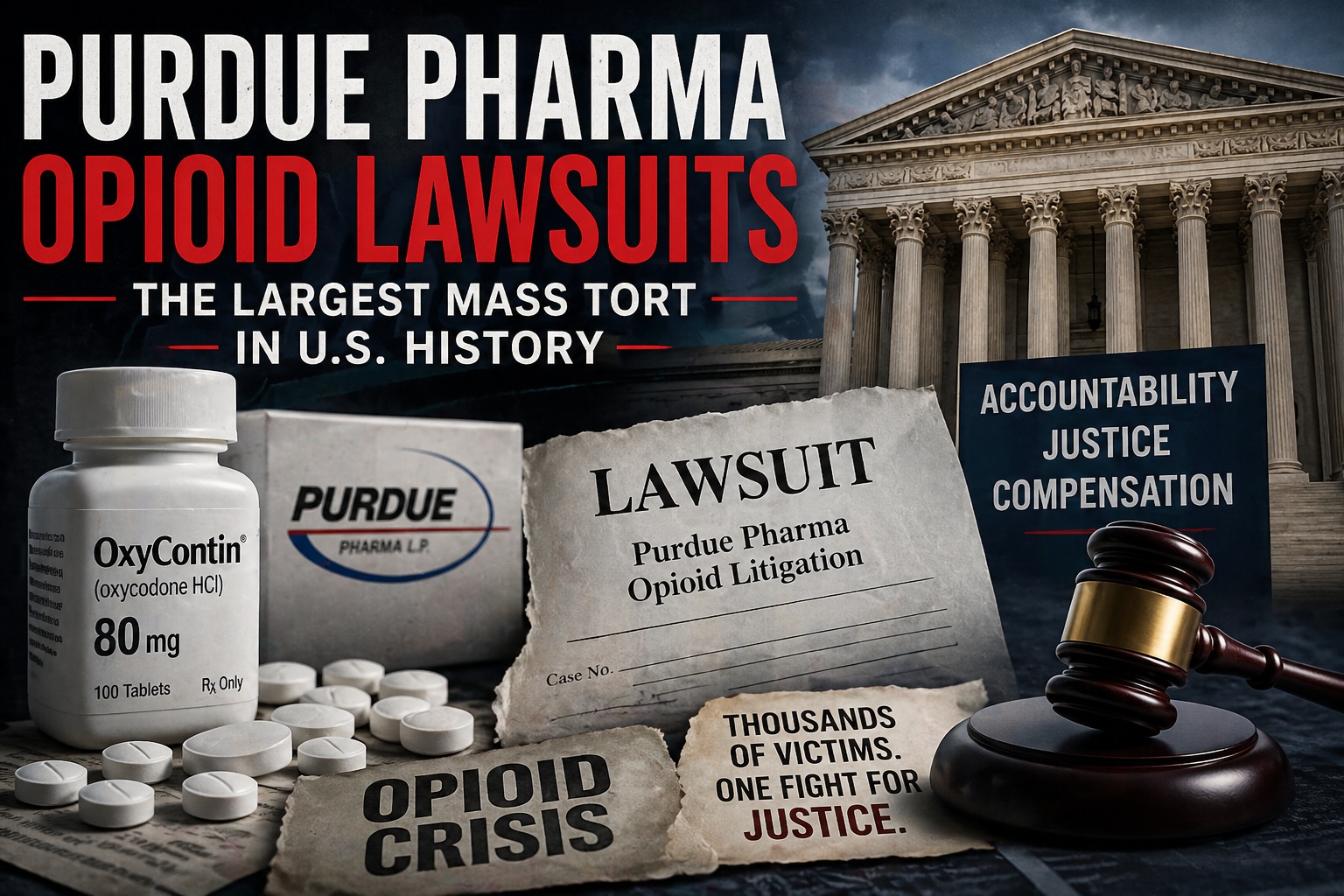
Purdue Pharma Opioid Lawsuits — The Largest Mass Tort in U.S. History
The litigation surrounding Purdue Pharma and its branded painkiller OxyContin stands as one of the most consequential legal undertakings in modern American history. Spanning more than two decades of aggressive opioid marketing, public-health catastrophe, and protracted court battles, the case has produced a sprawling web of opioid mass tort litigation involving every U.S. state, hundreds of municipalities, dozens of Native American tribes, hospital systems, insurers, and roughly 140,000 individual victims. By the time the OxyContin maker filed for Chapter 11 bankruptcy in 2019, claims against the company and its founding family were estimated to exceed forty trillion dollars in face value. The eventual outcome — a $7.4 billion nationwide opioid settlement confirmed by a federal bankruptcy court in November 2025 — reset the legal framework for pharmaceutical liability litigation and reshaped how mass tort cases are negotiated, financed, and resolved across the United States.
Following Major Mass Tort Lawsuits?
The Purdue Pharma opioid litigation reshaped how mass tort lawsuits, pharmaceutical liability, and national settlement funds are handled in the United States.
Explore Mass Tort LawsuitsHow Purdue Pharma Became the Center of the Opioid Crisis
Purdue Pharma introduced OxyContin to the U.S. market in 1996 after winning Food and Drug Administration approval for the controlled-release oxycodone formulation the prior year. From its launch, the drug was marketed to physicians and the general public as a breakthrough painkiller whose time-release mechanism dramatically reduced the risk of abuse and addiction compared with earlier opioid analgesics. That representation, regulators and prosecutors would later conclude, was unsupported by the underlying clinical evidence.
Throughout the late 1990s and into the 2000s, Purdue invested heavily in a sales force that visited high-prescribing clinicians, bankrolled continuing medical education on pain management, and helped popularize the now-discredited concept that physicians were systematically undertreating chronic pain. Prescription volumes for OxyContin climbed quickly, and the drug became one of the most-prescribed branded narcotics in the country. Public health researchers have linked the resulting expansion of prescription opioid use to the first wave of the modern opioid epidemic, which preceded the later surges driven by heroin and illicit fentanyl.
Purdue itself acknowledged misconduct in two separate federal criminal pleas. In 2007, the company and three executives pleaded guilty to charges connected to the misbranding of OxyContin. In 2020, Purdue entered a second guilty plea, this time to felony charges including conspiracy to defraud the United States and violations of federal anti-kickback statutes. Members of the Sackler family — who owned the privately held company and held seats on its board for decades — agreed to a separate civil resolution with the Department of Justice but did not personally plead guilty to criminal charges and have continued to deny wrongdoing.
The Explosion of Opioid Lawsuits Across the United States
As the public-health toll of the opioid crisis became impossible to ignore, civil litigation against Purdue and other supply-chain participants expanded rapidly. State attorneys general filed parens patriae actions on behalf of their residents. Cities and counties — particularly those overwhelmed by emergency-response, child-welfare, and corrections costs — pursued public-nuisance claims in their own right. Native American tribes, hospital systems, third-party payors, school districts, and ultimately individual victims and surviving family members joined the litigation as well.
Federal opioid litigation was eventually centralized in the Northern District of Ohio under Judge Dan Polster as Multidistrict Litigation No. 2804, the National Prescription Opiate Litigation. By the time Purdue filed its bankruptcy petition in September 2019, the company faced roughly 3,000 separate civil actions, with several hundred additional suits naming individual members of the Sackler family. The bankruptcy court that took jurisdiction over the company estimated the total face value of asserted claims at more than forty trillion dollars — a figure that, while almost certainly inflated by overlapping and theoretical demands, illustrates the unprecedented scope of the opioid epidemic lawsuits.
Have Questions About Active Mass Torts?
CredibleLaw tracks active and emerging mass tort lawsuits involving pharmaceutical drugs, defective products, consumer harms, and large-scale injury claims.
View Active Mass Torts See Emerging CasesWhy the Purdue Litigation Became the Largest Mass Tort in U.S. History
Several features set the Purdue Pharma opioid lawsuits apart from prior mass torts. First was the sheer breadth of plaintiffs. Where earlier waves of pharmaceutical liability litigation had centered on injured patients or their estates, the opioid mass tort drew in nearly every level of American government as a co-equal claimant. Second was the volume of individual victim claims: nearly 140,000 personal-injury claims were ultimately filed against Purdue, in addition to the thousands of governmental and institutional actions.
Third — and perhaps most distinctive — was the financial scale. Combined opioid settlements with manufacturers, distributors, and pharmacy chains have now exceeded $54 billion in publicly tracked recoveries, on a scale comparable only to the 1998 Master Settlement Agreement with the tobacco industry. The 2021 nationwide deal with the three largest pharmaceutical distributors — McKesson, Cardinal Health, and AmerisourceBergen (now Cencora) — alone committed up to $21 billion over eighteen years. A separate agreement with Janssen Pharmaceuticals and parent company Johnson & Johnson added up to $5 billion. Subsequent settlements with CVS, Walgreens, Walmart, Allergan, Teva, Kroger, McKinsey & Company, Mallinckrodt, Endo, Publicis Health, and a coalition of generic manufacturers brought total opioid crisis legal accountability recoveries past the $50 billion mark.
Within that broader litigation, the Purdue Pharma settlement remains uniquely significant. Unlike other opioid resolutions, which were structured almost entirely as government-to-government abatement transfers, the Purdue plan is the only national opioid settlement designed to deliver meaningful direct compensation to individual victims. That design feature, more than any single dollar figure, is what cements the Purdue case as the largest mass tort in U.S. history.
The Purdue Pharma Bankruptcy and Settlement Battles
Purdue filed for Chapter 11 protection in the U.S. Bankruptcy Court for the Southern District of New York on September 15, 2019. The filing triggered an automatic stay that halted the thousands of pending lawsuits against the company, and within weeks the bankruptcy court issued a preliminary injunction temporarily extending similar protection to non-debtor members of the Sackler family. From that point forward, the bankruptcy proceeding became the single forum in which virtually all opioid claims against Purdue would be resolved.
The original plan of reorganization, approved by Bankruptcy Judge Robert Drain in September 2021, called for the Sackler family to contribute approximately $4.325 billion in exchange for sweeping releases extinguishing existing and future opioid-related civil claims against family members and certain affiliated entities. Purdue itself would be reorganized into a public-benefit company — eventually known as Knoa Pharma — dedicated to opioid education, abatement, and the production of overdose-reversal medications. Eight states, the District of Columbia, Canadian municipalities, the City of Seattle, and the U.S. Trustee objected to the nonconsensual third-party releases granted to the Sacklers. The U.S. District Court vacated the confirmation order in December 2021, the Second Circuit reversed and reinstated it in May 2023, and the Supreme Court granted a stay in August 2023.
After lengthy renegotiation following the Supreme Court’s 2024 ruling, Purdue filed a substantially revised plan of reorganization on March 18, 2025. Under the new terms, the Sackler family agreed to contribute up to $6.5 billion over fifteen years and Purdue itself committed approximately $900 million in cash from the estate, producing a total cash value of roughly $7.4 billion to be distributed among states, local governments, tribes, and individual victims. Settlement funds are earmarked for opioid-use disorder treatment, prevention programming, victim compensation, and the funding of overdose-rescue medications. By June 2025, all 55 eligible U.S. states and territories had unanimously signed on. Bankruptcy Judge Sean Lane confirmed the revised plan on November 18, 2025, with the first $1.5 billion Sackler payment and the $900 million Purdue payment scheduled for early 2026.
Supreme Court Battles Over the Sackler Family Liability
The single most consequential legal question in the Purdue Pharma opioid litigation reached the U.S. Supreme Court in Harrington v. Purdue Pharma L.P. The case, argued December 4, 2023, asked whether a Chapter 11 plan could permanently extinguish opioid claims against members of the Sackler family — who had not themselves filed for bankruptcy — without the affirmative consent of the affected claimants. Court filings indicated that members of the Sackler family had withdrawn approximately $11 billion from Purdue in the years preceding the bankruptcy, with roughly $4.6 billion of that figure earmarked for tax obligations.
On June 27, 2024, the Court issued a 5-4 decision authored by Justice Neil Gorsuch and joined by Justices Thomas, Alito, Barrett, and Jackson. The majority held that the Bankruptcy Code does not authorize a reorganization plan to discharge the debts of a non-debtor over the objection of affected creditors. The opinion read Section 1123(b)(6) of the Code — the statutory catchall provision the lower courts had relied on — narrowly, applying the canon of ejusdem generis to limit it to authorities of a kind already enumerated elsewhere in the section. The Court further observed that the Sacklers had not placed substantially all of their assets on the table as a true debtor in bankruptcy would be required to do, yet sought a release covering claims for fraud, willful injury, and even wrongful death that ordinarily cannot be discharged at all. Justice Brett Kavanaugh, joined by Chief Justice Roberts and Justices Sotomayor and Kagan, filed a sharply worded dissent describing the majority’s approach as a departure from decades of bankruptcy practice and warning that opioid victims would bear the practical cost of the ruling.
The decision did not address the validity of consensual third-party releases or releases authorized by Congress in specific contexts such as asbestos bankruptcies, and the majority described its holding as narrow. Even so, the ruling fundamentally changed the negotiating posture of the Purdue case and is now widely regarded as the most important bankruptcy-law decision in a generation. It directly forced the renegotiation that produced the larger 2025 settlement, and it has reshaped the structure of every subsequent opioid bankruptcy litigation and mass-tort restructuring in the federal courts.
Latest Developments in the Purdue Pharma Case
With confirmation of the revised plan in November 2025, the Purdue Pharma litigation has entered its implementation phase. The reorganized company will exit bankruptcy as an independent public-benefit entity owned by a nonprofit foundation, with the Sackler family permanently barred from any management role, ownership interest, or compensation tied to opioid sales. A court-appointed monitor will continue to supervise compliance, and the company remains enjoined from marketing opioid products or lobbying on opioid-related policy.
The first wave of payments — including the $1.5 billion initial Sackler installment and Purdue’s $900 million contribution — is scheduled for early 2026, with subsequent Sackler payments of $500 million after one year, an additional $500 million after two years, and $400 million after three years. Approximately 30 million internal Purdue and Sackler documents are expected to be made public through a court-ordered repository, providing researchers, journalists, and future plaintiffs unprecedented insight into the company’s marketing and corporate-governance history.
Implementation has not been without controversy. Reporting published in April 2026 by ProPublica and the Philadelphia Inquirer found that nearly half of the roughly 140,000 individual claimants are unlikely to receive any compensation under the revised criteria, in part because the new plan eliminated an earlier provision permitting victims to substantiate OxyContin purchases through sworn affidavits when prescription records were unavailable. Advocacy organizations have called for procedural revisions, and additional litigation over claim eligibility is widely anticipated as the Personal Injury Trust begins disbursements.
How the Opioid Litigation Changed Mass Tort Law
The Purdue Pharma proceedings, together with the broader opioid bankruptcy litigation involving Mallinckrodt, Endo, and other manufacturers, have already begun to reshape American mass tort doctrine. The most direct legal legacy is the Harrington decision itself, which has effectively ended the practice of using nonconsensual third-party releases as a mass-tort settlement mechanism in Chapter 11. Practitioners now structure deals around either consensual releases — supported by robust opt-in solicitation procedures — or larger debtor contributions that obviate the need for nondebtor protection.
Beyond the bankruptcy context, the opioid litigation accelerated the maturation of public-nuisance theory as a vehicle for governmental plaintiffs, validated the use of multidistrict litigation as a coordination tool in cases involving thousands of governmental and institutional plaintiffs, and demonstrated that complex pharmaceutical liability litigation can be resolved on a global, supply-chain basis rather than defendant-by-defendant. Compared to earlier benchmarks such as the asbestos, tobacco, and Vioxx mass torts, the opioid wave is distinctive for its unusual mix of governmental abatement claims and individual personal-injury claims within the same proceedings, for the magnitude of injunctive relief obtained, and for the central role of bankruptcy courts as de facto forums for nationwide tort resolution.
These structural innovations are already being borrowed in active and emerging mass tort lawsuits involving products as varied as PFAS contamination, social-media platforms, and hair-relaxer formulations. Whether the resulting framework adequately compensates individual victims — as opposed to governmental entities tasked with abatement — remains a central and contested question among scholars, regulators, and plaintiffs’ counsel.
Active and Emerging Mass Tort Lawsuits
Major pharmaceutical liability litigation continues to evolve, and the doctrinal lessons of Purdue are being applied across a growing slate of pharmaceutical, consumer-product, and environmental cases. Readers researching pending and emerging litigation can review CredibleLaw’s broader coverage of mass torts along with detailed dockets in our mass tort lawsuits, active mass torts, emerging mass torts, and mass tort investigations sections. These resources catalog both currently consolidated MDLs and matters in earlier investigative stages, with continually updated procedural status, key rulings, and settlement context.
Legal Options for Victims of Pharmaceutical Harm
Individuals who believe they were harmed by a prescription pharmaceutical product generally have several avenues of legal recourse. They may join an active mass tort or multidistrict litigation when one is consolidated against the manufacturer. They may file an individual lawsuit in state or federal court, particularly where their claims involve unique facts that do not align with bulk-settlement criteria. In cases where a defendant has filed for bankruptcy, prospective plaintiffs must typically submit a proof of claim in the bankruptcy proceeding and follow that court’s procedural deadlines, which are frequently shorter and stricter than ordinary state-court statutes of limitations.
Selecting the correct procedural vehicle requires careful evaluation of the available evidence, the jurisdiction in which the claim arises, and the current posture of any consolidated proceedings. Readers seeking general legal information about mass torts and pharmaceutical liability litigation can explore additional resources at CredibleLaw or get in touch through the firm’s contact page. This article is intended as legal journalism and educational analysis only and does not constitute legal advice; readers with potential claims should consult a qualified attorney licensed in their jurisdiction.
Need Help Understanding a Mass Tort Claim?
If you believe you may be affected by a major lawsuit or investigation, learn more about how mass tort cases work and how to review your legal options.
Contact CredibleLawCredibleLaw provides legal information and may connect users with independent legal professionals. This content is not legal advice.
Frequently Asked Questions
What is the Purdue Pharma opioid lawsuit?
The phrase “Purdue Pharma opioid lawsuit” refers collectively to the thousands of civil actions filed against Purdue Pharma and members of the Sackler family alleging that the company’s marketing of OxyContin contributed to the U.S. opioid crisis. Plaintiffs include all 50 states, the District of Columbia, U.S. territories, thousands of cities and counties, Native American tribes, hospitals, insurers, and roughly 140,000 individual claimants. The litigation has been resolved primarily through Purdue’s Chapter 11 bankruptcy proceeding in the Southern District of New York.
How many lawsuits were filed against Purdue Pharma?
By the time Purdue filed for bankruptcy in September 2019, the company faced approximately 3,000 separate civil actions, with several hundred additional cases naming individual Sackler family members. Roughly 140,000 personal-injury claimants subsequently filed proofs of claim in the bankruptcy proceeding, and government plaintiffs from all 55 eligible U.S. jurisdictions are participating in the global settlement.
How much is the Purdue Pharma settlement?
The confirmed 2025 settlement has a total cash value of approximately $7.4 billion. Members of the Sackler family will contribute up to $6.5 billion over fifteen years, and the reorganized Purdue estate will contribute approximately $900 million. Most settlement funds are designated for state and local opioid abatement, with a dedicated trust providing direct compensation to individual victims.
What role did the Sackler family play?
The Sackler family owned and controlled Purdue Pharma for decades and held multiple seats on the company’s board during the period when OxyContin was developed and marketed. Court records indicate that family members withdrew approximately $11 billion from the company in the years preceding the bankruptcy filing. Family members have consistently denied personal wrongdoing and did not file for individual bankruptcy. Under the confirmed 2025 plan, the Sacklers will exit any role in Purdue and are permanently barred from manufacturing, marketing, or selling opioids in the United States.
Can victims still file opioid lawsuits?
Claims against Purdue itself are governed by the bankruptcy proceeding, and the deadline for filing individual personal-injury claims against Purdue has passed. However, opioid-related litigation against other manufacturers, distributors, pharmacies, and prescribers continues across multiple jurisdictions, and new investigations into related pharmaceutical and supply-chain conduct are ongoing. Individuals who believe they were harmed by an opioid product should consult a licensed attorney promptly to evaluate their options under applicable statutes of limitations.
About CredibleLaw
CredibleLaw provides independent legal analysis, lawsuit updates, and educational resources covering mass tort litigation, pharmaceutical liability, consumer-protection cases, and emerging areas of complex civil practice in the United States. Our coverage is researched from primary court records, agency filings, and reputable national reporting, with a focus on giving readers a clear and balanced picture of how major litigation is unfolding. To explore additional reporting on the cases discussed in this article, visit our mass torts hub or learn more about CredibleLaw.


