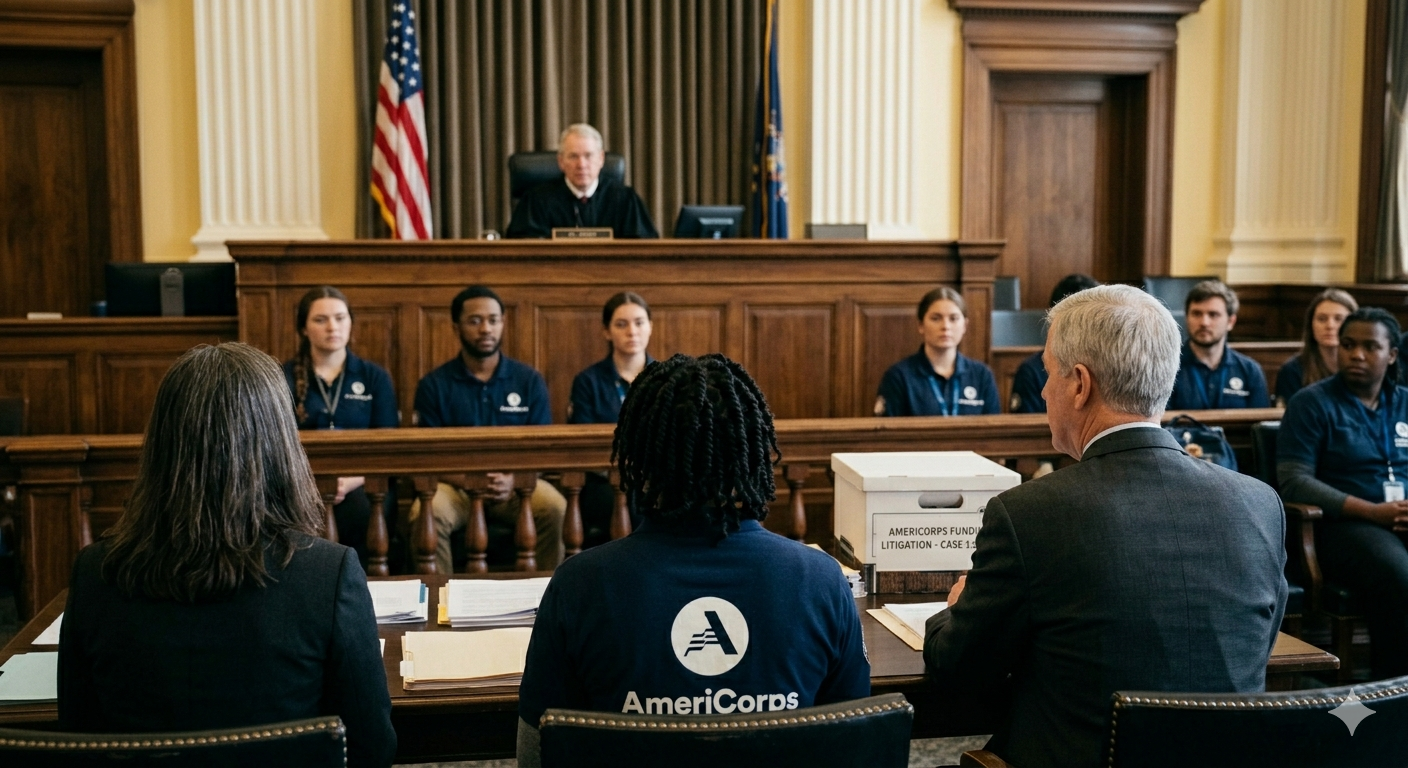
AmeriCorps Funding Restoration Lawsuit
Understanding the Legal Battle to Reinstate America’s National Service Grants
The AmeriCorps funding restoration lawsuit represents one of the most consequential public service legal battles of the decade — a fight that tests the limits of federal executive power, the Administrative Procedure Act (APA), and the future of community-based national service.
If you’ve worked within a nonprofit, state service commission, or direct AmeriCorps program like VISTA, NCCC, or Seniors, you’ve already felt the whiplash: grants suspended, members demobilized, and positions “paused” indefinitely — only to be revived through a court injunction months later.
Now, in 2026, claimants are waiting for distribution, reinstatement, or backpay. As of March 2026, those questions remain active due to appeal delays in Maryland et al. v. CNCS, Case No. 1:25‑cv‑01363.
Having litigated multi‑district and class cases for nearly three decades, I’ll use this page to cut through the bureaucratic noise and break down what really matters — legally, financially, and practically — as this restoration process unfolds.
1. The Legal Foundation: What Triggered the AmeriCorps Funding Restoration Lawsuit
When the Office of Management and Budget (OMB) announced in April 2025 its intent to “pause and reevaluate” all federal AmeriCorps grants, it effectively froze over $400 million in active awards. Overnight, hundreds of nonprofit placements, youth corps, university partnerships, and tribal service programs shuttered.
Dozens of state attorneys general, led by Maryland and California, filed suit in federal district court (District of Maryland) arguing that the mass terminations violated the Administrative Procedure Act (APA). Under the APA, agencies cannot abruptly rescind funding or change policy without:
- Providing adequate notice and comment;
- Demonstrating a rational basis supported by the administrative record; and
- Following established rulemaking procedures.
Judge Boardman’s Injunction
On June 5, 2025, Judge Deborah L. Boardman issued an 86‑page Memorandum Opinion enjoining the administration from enforcing the terminations. Her reasoning was unambiguous: the OMB lacked statutory authority to unilaterally dissolve or freeze congressionally appropriated service grants.
Case Reference: Civil Rights Litigation Clearinghouse – State of Maryland v. CNCS
This restored funding pending appeal, ordering the Corporation for National and Community Service (CNCS, now branded AmeriCorps Agency) to:
- Resume processing State and National awards;
- Reinstate living allowances for active members; and
- Notify previously suspended grantees of continuing eligibility.
2. Where the Case Stands in 2026
The Russo v. Walgreen Co. Parallel – Managing the Waiting Period
While this case concerns public grants, applicants face the same procedural purgatory familiar from the Prescription Savings Club settlement: the period after a fairness hearing but before check distribution.
As of early 2026, the Fourth Circuit appeal in Maryland v. CNCS remains pending; the injunction stands, but final funding disbursement is slowed by administrative reconciliation, similar to how the Russo v. Walgreen Co. appeal has delayed settlement checks in consumer actions.
The Fiscal Context
Complicating matters, the FY 2026 Budget Justification submitted by the AmeriCorps Office of Inspector General still requests $107.6 million to “facilitate an orderly shutdown.”
That creates dual realities:
- Legally, AmeriCorps must maintain the restored programs.
- Budgetarily, the agency is preparing for phased dissolution if the appeal reverses the injunction.
Authority: AmeriCorps FY 2026 Congressional Budget Justification (PDF)
3. The Broader Class‑Action Analogy: Lessons from Pharmacy Settlements
Many nonprofit administrators are asking how the AmeriCorps Funding Restoration litigation compares to consumer class actions such as the $100 million Prescription Savings Club (PSC) settlement against Walgreens, or the ongoing Lidocaine/PFAS medical‑product cases.
A. “Usual and Customary” Pricing Theory in the PSC Settlement
In Russo v. Walgreen Co., plaintiffs alleged Walgreens failed to report the lower “Prescription Savings Club” member rates as its Usual & Customary (U&C) price to insurers.
Under federal and state fraud statutes, pharmacies must bill payors the actual customary price — not inflated list prices. By misreporting these prices, Walgreens allegedly overcharged both insurers and consumers.
Ultimately, Walgreens agreed to a $100 million settlement, reaffirming that pricing transparency is more than accounting; it’s compliance.
The MDL‑style oversight structure for distributing those payments mirrors the process forming around AmeriCorps grant restoration.
B. Lidocaine and PFAS Bandage Investigations
Currently, the FDA and product‑liability bar are scrutinizing “maximum strength” lidocaine patches and PFAS‑containing wound bandages. Plaintiffs argue strict‑liability and failure‑to‑warn theories, claiming undisclosed carcinogenic exposure.
The lesson for AmeriCorps stakeholders?
Whether you’re a consumer in an MDL or a grantee in a funding injunction, data fidelity matters. The trail of documentation — price records or grant draws — defines who gets compensated and when.
4. Practical Claimant and Grantee Guidance
Beyond Filing — How to Maximize Restoration Eligibility
Many state commissions and nonprofits have technically “filed,” but that’s only step one. Based on long experience with settlement administrators:
- Document Your Program Interruption. Keep contemporaneous records of personnel layoffs, member demobilization dates, and communication from AmeriCorps program officers.
- Coordinate With Third‑Party Payors (TPPs). For healthcare‑related AmeriCorps initiatives (especially public‑health placements under VISTA), verify data with your TPPs, since fiscal intermediaries often hold payment ledgers essential to reimbursement.
- Engage Your State Commission. Programs reinstated under the injunction must channel reauthorization through their commission. Direct agency filings may be rejected without state validation.
- Monitor eGrants Accuracy. Several 2025 entries were zeroed‑out during the “DOGE Pause.” Restoring those records ensures correct education‑award credits later.
5. The “Red Flag” Guide — Identifying Legitimate Court or Administrator Notices
With over one million potential claimants, phishing and scam activity has surged. My office now spends as much time validating communications as drafting motions.
Here’s what distinguishes real notices from fraud:
| Indicator | Legitimate Court Communication | Possible Scam |
|---|---|---|
| Sender Domain | @americorps.gov, @md.uscourts.gov, or @rustconsulting.com | Free email (Gmail, Outlook, Proton) |
| Case Numbers | Always include 1:25‑cv‑01363 | Omitted or nonsensical case refs |
| Payment Language | Refers to “reimbursement,” “restoration,” or “stipend recalculation” | Demands “processing fees,” “bond deposits,” or “expedited release” |
| Delivery Method | USPS, FedEx, or EDM via court‑approved distributor | Social‑media DMs, texts, or links requesting login credentials |
If uncertain, cross‑verify with the docket at the Civil Rights Litigation Clearinghouse or your state service commission’s official portal.
Treat any solicitation for banking information as fraudulent.
6. Strategic Insight: Navigating the Waiting Period
Litigation veterans know that the limbo between final approval and payment can drag beyond public expectations. The AmeriCorps funding restoration payouts are no different.
Key dynamics affecting timing:
- Appeal Bond Requirements: The federal government isn’t exempt; to stay distribution pending appeal, it must post an adequate record of intent — a procedural hurdle that can take months.
- Administrative Backlog: The CNCS Grants Office must verify use‑of‑fund data for each reinstated program. Small nonprofits without full fiscal staff face delays here.
- Parallel Labor Litigation: AFSCME Local 2027 and Democracy Forward continue to litigate employee‑side reinstatement, siphoning executive bandwidth.
Authority: Democracy Forward – AFSCME v. Vought & AmeriCorps
What To Do During the Wait
- Update DUNS/SAM Registration. Payments and reinstatements cannot process to lapsed federal identifiers.
- Retain All Correspondence. Settlement administrators often request copies of prior award letters.
- Avoid Double‑Filing. Multiple grant identifiers for the same program can delay reconciliation.
- Stay Patient but Proactive. Every legitimate distribution I’ve overseen required claimant persistence and administrative patience in equal measure.
7. Mapping the Stakeholders
| Sector | Primary Impact | Legal Mechanism |
|---|---|---|
| AmeriCorps State & National Grantees | Program continuity; staff rehiring | APA Injunction Enforcement |
| AmeriCorps VISTA Members | Lost stipends, education awards | Wage‑and‑hour claims; backpay petitions |
| AmeriCorps Seniors & Foster Grandparent Programs | Service continuity for seniors | Contract revalidation through State Commissions |
| Tribal Nation Programs | Interrupted cultural restoration projects | 25 U.S.C. statutory funding guarantees |
| University‑Based Service Programs | Canceled research partnerships | Federal‑state subgrant litigation |
For state‑level analysis, the California DOJ continues publishing multi‑state coalition updates:
Resource: CA DOJ Press Release – Restoration of Withheld AmeriCorps Funds
8. Historical Parallels — From Pharmaceutical MDL to National Service Litigation
The AmeriCorps dispute may be administrative on the surface, but its litigation DNA mirrors multi‑district litigation (MDL) structure in pharmaceutical or consumer fraud contexts.
| Element | Consumer MDL Example | AmeriCorps Litigation Parallel |
|---|---|---|
| Centralized Jurisdiction | In re Opioid MDL (N.D. Ohio) | Maryland District Court, Judge Boardman |
| Injunction / Settlement Oversight | Special Master audits | State Service Commission verification |
| Data Aggregation Challenge | Pharmacy billing records | eGrants and state sub‑award data |
| Claimant Fatigue | Long waiting periods | Restoration‑check delays |
Both models demonstrate a federal court’s capacity to enforce systemic fairness when administrative agencies fail their statutory duties.
9. The Broader Policy Significance
If the injunction holds, Maryland v. CNCS could become the blueprint for future Transparency in Pharmacy Pricing and Retail Health Toxic Tort doctrines — proving that public‑interest litigation can compel accountability far beyond its narrow subject.
Likewise, the funding‑restoration effort strengthens the separation‑of‑powers principle: Congress appropriates; agencies execute; the White House cannot unilaterally cancel.
Even within consumer‑protection law, this decision echoes the reasoning behind U&C pricing and labeling cases — the same legal DNA connects an inaccurately labeled adhesive bandage to a wrongly terminated national‑service grant.
10. The Future Outlook (2026 and Beyond)
A. Pending Appeal (August 2026)
If the government wins its appeal, expect an immediate administrative claw‑back of unspent restored funds. Programs mid‑cycle could find themselves unable to process stipends or Segal Education Awards.
If the plaintiffs prevail, the injunction could crystalize into a permanent declaratory judgment, forcing restoration and possibly awarding attorney fees under 28 U.S.C. § 2412.
B. Legislative Alignment
Bipartisan appropriators have already introduced budget riders tying AmeriCorps appropriations to compliance with existing judicial orders. Expect “conditional funding” provisions embedded in FY2027 continuing resolutions to prevent executive reversals.
C. Ethical and Practical Lessons
- Document everything. Federal judges rely on evidence, not politics.
- Expect long timelines. Even favorable rulings take months to materialize into checks.
- Stay vigilant about misinformation. Scams fill the vacuum of uncertainty.
11. Frequently Asked Questions (FAQ)
Is my AmeriCorps grant actually restored following the preliminary injunction?
Yes, if you received written reinstatement under the Maryland injunction. Operational funding resumes but remains subject to appellate review.
Can I get backpay for the “DOGE Pause” or April 2025 “Friday Night Massacre”?
Potentially. Programs documenting furloughs or suspended stipends are prioritized for reimbursement once the court finalizes budget authority.
How do I “undo” a member termination in eGrants to restore service hours?
File an “Administrative Correction” request citing the June 2025 injunction. AmeriCorps’ Program Accountability Office must reopen the record before service hours apply toward education awards.
Does the court ruling apply to federal AmeriCorps staff or just grant‑funded members?
Both categories are indirectly protected. The staff layoffs were addressed in AFSCME v. Vought, while grant program reinstatement falls under Maryland v. CNCS.
Will my Segal Education Award be prorated if my program was temporarily shut down?
Yes. Awards are calculated on proportional service completed unless reinstated service hours are recorded retroactively.
What happens if the government wins its appeal in August 2026?
Funding may be rescinded. The court could stay claw‑backs pending Supreme Court petition, but program continuity would depend on congressional appropriations.
Is AmeriCorps being eliminated in the FY 2026 budget?
Not formally, though the OIG request includes shutdown funding. Congress retains final control.
Which states are currently protected under the injunction?
All 52 state service commissions covered by the America’s Service Commissions network fall within the injunction’s scope.
Resource: ASC News & Statements
Can I transfer from a federal AmeriCorps program to a state‑funded service corps?
Yes, provided both programs concur and funding overlaps remain uninterrupted.
How do I report retaliatory discharge or grant audits tied to the lawsuit?
Use the AmeriCorps OIG online portal or contact a qualified AmeriCorps funding restoration lawyer experienced in whistleblower retaliation under the False Claims Act.
12. Final Thoughts — Experience and Empathy in an Unusual Legal Climate
After thirty years litigating federal consumer and funding disputes, one truth endures: the law always lags behind the human impact.
Waiting for checks, reinstatements, or backpay is frustrating. The administrative churn feels endless. But these cases — whether they concern overpriced prescriptions, toxic adhesives, or national‑service grants — all serve the same democratic purpose: holding institutions accountable to their statutes and commitments.
If you or your organization are navigating this process, seek counsel early. A knowledgeable federal grant restoration litigator can validate documents, communicate with administrators, and guard you against scams that prey on uncertainty.
The AmeriCorps funding restoration lawsuit isn’t just about money. It’s about reaffirming that public service — and the people who deliver it — cannot be erased by executive memo.
Need experienced representation?
Contact Credible Law, a national alliance of consumer‑protection and class‑action attorneys focused on financial fairness and government accountability.

