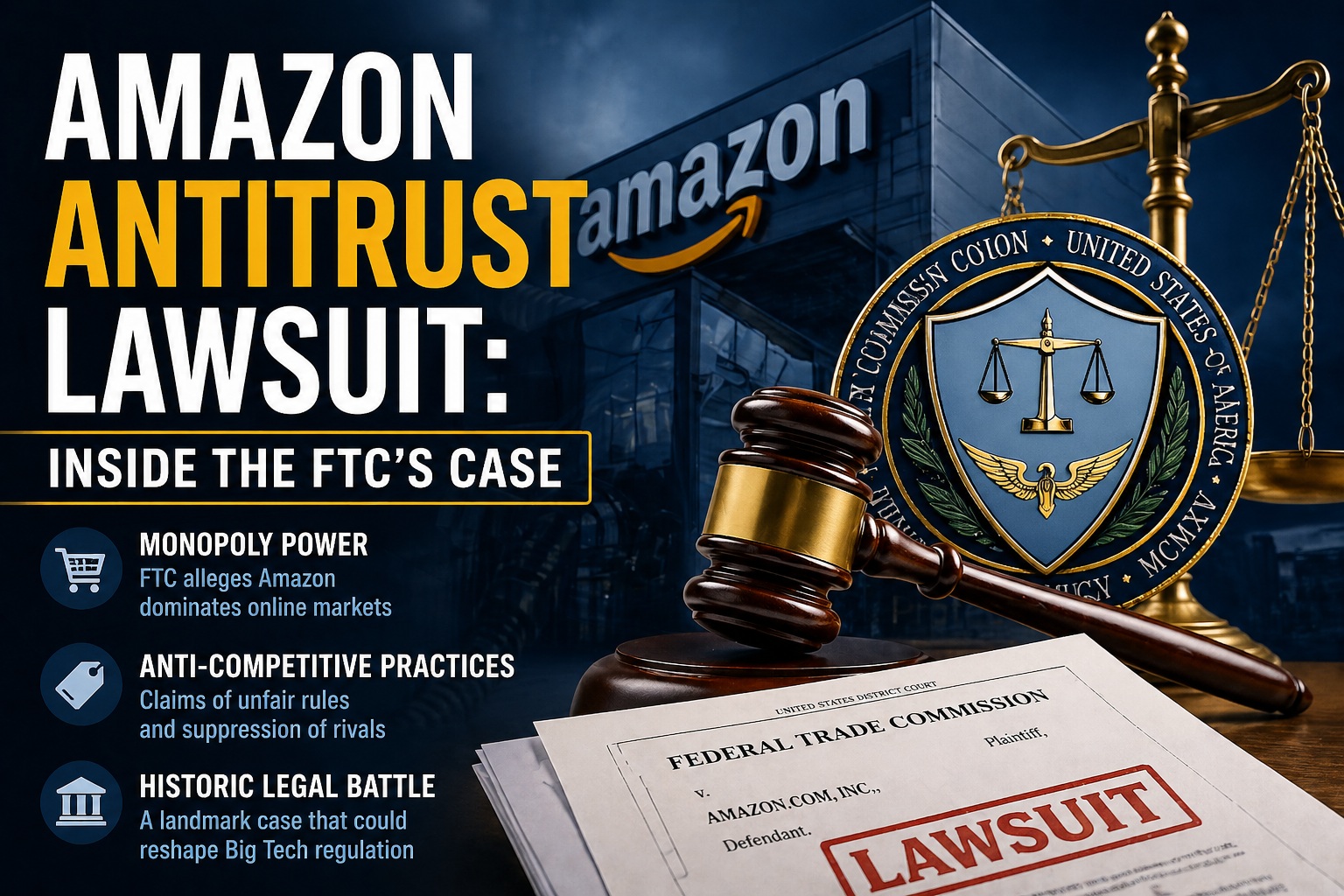
Amazon Antitrust Lawsuit: Inside the FTC’s Case
In September 2023, the Federal Trade Commission and a coalition of state attorneys general filed what may be the most consequential antitrust lawsuit of the past two decades. The target was Amazon — the dominant force in online retail, the operator of the Marketplace that hosts millions of third-party sellers, and the company whose logistics network has become embedded in the daily commerce of nearly every American household. The complaint alleges that Amazon has illegally maintained monopoly power in two distinct markets and has done so through a coordinated set of strategies that harm sellers, suppress competition, and ultimately raise prices for consumers.
The case sits within a broader era of heightened scrutiny of large technology platforms. Federal regulators, state enforcers, and bipartisan voices in Congress have increasingly questioned whether existing antitrust doctrine is equipped to police the conduct of digital giants whose market power is built on network effects, data advantages, and tightly integrated ecosystems of services. The Amazon case has been compared, in scope and significance, to the landmark monopolization actions of the past — including those against Microsoft and AT&T — and its outcome could shape the legal framework for digital competition for a generation.
Regulators allege that Amazon used several interlocking strategies — anti-discounting policies, conditional Prime eligibility, search and Buy Box manipulation, and aggressive marketplace fees — to maintain monopoly power and prevent rivals from gaining the scale needed to compete. Amazon has denied the allegations, characterizing the conduct at issue as routine retail practices that benefit consumers. Whether the court agrees will not be decided until trial, currently set for early 2027.
This article provides a neutral, in-depth look at the lawsuit: who filed it, what it alleges, the legal framework that governs it, what is at stake for sellers and consumers, and why it matters for the broader future of competition law in the digital economy.
What Is the Amazon Antitrust Lawsuit?
The Amazon antitrust lawsuit is a federal civil enforcement action brought by the U.S. Federal Trade Commission alongside a coalition of state attorneys general. It alleges that Amazon.com, Inc. has illegally maintained monopoly power in violation of federal and state antitrust laws.
Case Reference
The official case caption is Federal Trade Commission, et al. v. Amazon.com, Inc., docketed in the United States District Court for the Western District of Washington under case number 2:23-cv-01495-JHC. The matter is assigned to U.S. District Judge John H. Chun. The case was filed on September 26, 2023, following a multi-year investigation by FTC staff and the participating state offices.
Plaintiffs
The lawsuit was filed by the FTC together with the attorneys general of eighteen states and Puerto Rico. The participating jurisdictions span the political spectrum and represent a broad cross-section of the U.S. economy, reflecting the bipartisan nature of the underlying competition concerns. The state attorneys general bring parallel claims under their respective state antitrust statutes, which in many instances mirror the federal Sherman Act.
Forum
The case is being heard in federal district court in Seattle, where Amazon is headquartered. Venue in the Western District of Washington reflects both Amazon’s principal place of business and the location of much of the relevant evidence and witness testimony. The case is proceeding as a bench trial, meaning the dispute will be decided by Judge Chun rather than a jury.
Relief Sought
Plaintiffs seek a permanent injunction restraining Amazon from continuing the conduct alleged in the complaint, along with other equitable relief that the court determines is necessary to restore competition. According to the Federal Trade Commission, the agency’s stated goal is to dismantle the alleged monopoly maintenance scheme and prevent its recurrence. In antitrust litigation of this scale, available remedies can extend to behavioral restrictions and, in some cases, structural changes to a defendant’s business.
Why the FTC Says Amazon Is a Monopoly
At the heart of the case is the FTC’s contention that Amazon possesses monopoly power in two interrelated but distinct markets. The agency alleges that Amazon has unlawfully maintained that power through a course of exclusionary conduct rather than through superior products, business acumen, or historical accident — the traditional safe harbors recognized by antitrust law.
The Two Relevant Markets
The complaint defines two relevant antitrust markets that, the FTC argues, Amazon dominates:
- The online superstore market — the broad-assortment, single-destination online retail experience that serves shoppers seeking to purchase across many product categories in one place.
- The online marketplace services market — the suite of services Amazon sells to third-party sellers who use the Marketplace to reach consumers, including listing infrastructure, fulfillment, advertising, and Prime eligibility.
The FTC alleges that Amazon’s conduct in one market reinforces its dominance in the other, producing a self-reinforcing cycle in which scale on the consumer side compels seller participation, and seller participation deepens scale on the consumer side. Amazon disputes the validity of these market definitions, arguing that consumers shop across a broader set of online and brick-and-mortar retailers and that any market definition limited to a handful of online platforms misrepresents how shopping actually occurs.
How Antitrust Law Defines Monopoly Power
Under U.S. antitrust law, possessing monopoly power is not by itself unlawful. The legal violation arises when a firm with monopoly power engages in exclusionary or anticompetitive conduct to acquire or maintain that power — as opposed to outcompeting rivals on the merits. Courts typically assess monopoly power through two lenses: the firm’s share of a properly defined relevant market, and direct evidence of the firm’s ability to control prices or exclude competition. The FTC alleges both: that Amazon commands a dominant share of the online superstore and online marketplace services markets, and that Amazon’s conduct demonstrates the kind of unconstrained pricing and exclusionary leverage that monopoly power confers.
Why Market Definition Matters
Market definition is often the most contested issue in monopolization cases, and it is where Amazon has focused much of its early defense. If a court accepts the FTC’s narrow definitions, Amazon’s market shares appear dominant. If the court instead defines the relevant markets more broadly — to include, for example, all retail (online and offline) — Amazon’s market share would be far smaller, and a monopoly claim becomes much harder to sustain. This issue was previewed in the briefing on Amazon’s motion to dismiss and is expected to remain central through trial.
Key Antitrust Allegations Against Amazon
The complaint identifies several interlocking practices that the FTC and state plaintiffs say, taken together, constitute unlawful monopoly maintenance. Each allegation is contested by Amazon.
Anti-Discounting Policies
The plaintiffs allege that Amazon penalizes sellers who offer the same product at a lower price on competing platforms — including the seller’s own website. According to the complaint, sellers who do so risk losing visibility in Amazon’s search results, losing the prominent Buy Box placement that drives the majority of marketplace sales, or being subjected to other adverse treatment within the platform. The FTC argues that this practice prevents price competition between Amazon and rival online platforms, effectively keeping prices higher across the broader online retail market.
The complaint also describes an internal pricing algorithm Amazon called “Project Nessie,” which the FTC alleges was used to identify products where Amazon could raise prices and predict that competitors would follow. According to the plaintiffs, the algorithm allowed Amazon to extract significant additional revenue while testing the competitive constraints in the market. Amazon has stated publicly that the FTC mischaracterizes the tool and that the company stopped using it years ago, having designed it to prevent unsustainable pricing rather than to extract monopoly rents.
Search Manipulation and Buy Box Featuring
The complaint alleges that Amazon biases its search and product-presentation algorithms in ways that favor Amazon’s own private-label products and Marketplace sellers who use Amazon’s fulfillment and advertising services. A central allegation involves the Buy Box — the prominent on-page feature where customers add items to their cart with a single click. According to the plaintiffs, when a seller offers the same product at a lower price elsewhere, Amazon may suppress that seller’s Buy Box placement, thereby hiding the better deal from consumers. Amazon characterizes its algorithms as designed to surface the best customer experience and disputes the suggestion that lawful product curation amounts to anticompetitive conduct.
Conditioning Prime Eligibility on Fulfillment by Amazon
The plaintiffs allege that Amazon ties the desirable Prime badge — which is critical for sales velocity on the Marketplace — to the seller’s use of Fulfillment by Amazon (FBA), Amazon’s logistics service. By conditioning Prime eligibility on FBA usage, the FTC argues, Amazon raises sellers’ costs of multi-homing across platforms, because sellers who want Prime eligibility on Amazon must commit inventory to FBA and incur the costs of splitting inventory across multiple fulfillment networks if they wish to sell on competing platforms. The FTC contends that this practice reinforces Amazon’s grip on both the online superstore market and the marketplace services market.
Marketplace Fees and the Cost Stack on Sellers
The complaint describes a layered fee structure imposed on third-party sellers, including referral fees, fulfillment fees, advertising costs, and various optional or quasi-mandatory program fees. The FTC alleges that these costs, in aggregate, can consume a substantial share of seller revenue. Because Amazon’s anti-discounting policies prevent sellers from passing those costs through as lower prices on competing platforms, the FTC argues that the marketplace fee burden is ultimately reflected in higher consumer prices across the entire online retail ecosystem. Amazon’s position is that its fees reflect the value of the services provided and that sellers retain meaningful control over how they price and where they sell.
Advertising Dominance and the Replacement of Organic Results
The complaint also alleges that Amazon has progressively replaced organic search results with paid placements — what the plaintiffs describe as junk ads — and that this practice degrades the consumer experience while extracting substantial revenue from sellers who feel compelled to advertise to maintain visibility. The FTC frames this as a quality degradation that a competitive market would not tolerate, evidence that Amazon’s monopoly position insulates it from the discipline that competition would otherwise impose. Amazon counters that its advertising products are lawful, widely used, and consistent with industry practice.
The Court’s Initial Ruling
On September 30, 2024, Judge Chun denied Amazon’s motion to dismiss in significant part. The court allowed all of the FTC’s federal claims under Section 2 of the Sherman Act and Section 5(a) of the FTC Act to proceed, along with most state-law claims. A small subset of state claims — involving specific elements of allegations brought by certain states — was dismissed. The ruling was a substantial procedural win for the plaintiffs, though as the court itself noted, dismissal-stage rulings assume the truth of the complaint’s allegations and do not resolve the merits. Amazon will have the opportunity to test those allegations through discovery and at trial.
How Antitrust Law Applies to Big Tech
U.S. antitrust law rests on a small number of statutes, but the application of those statutes to digital platforms has become one of the most actively contested areas of legal scholarship and enforcement practice.
Section 2 of the Sherman Act
Section 2 of the Sherman Act, enacted in 1890, is the principal federal statute prohibiting monopolization. It makes it unlawful to monopolize, attempt to monopolize, or conspire to monopolize any part of interstate or foreign commerce. To prove monopolization, a plaintiff must establish two elements: that the defendant possesses monopoly power in a relevant market, and that the defendant has engaged in willful conduct to acquire or maintain that power, as distinguished from growth or development from a superior product, business acumen, or historic accident. The FTC’s case against Amazon is centered on Section 2, with the plaintiffs alleging both possession of monopoly power and a course of exclusionary conduct designed to maintain it.
Section 5 of the FTC Act
Section 5 of the FTC Act prohibits unfair methods of competition. The provision is broader than the Sherman Act and reaches conduct that may not strictly fall within Sherman Act categories but that the Commission considers anticompetitive. In recent years, the FTC has signaled an intent to use Section 5 more aggressively, and the Amazon case reflects that posture. The court’s decision to allow the FTC’s Section 5(a) claim to proceed past the motion to dismiss stage was a notable procedural development.
Monopolization Versus Competition
A critical principle running through U.S. antitrust law is that being a monopolist is not, by itself, unlawful. Firms that achieve dominance through innovation, efficiency, or quality are not penalized for their success. The legal violation arises only when monopoly power is acquired or maintained through exclusionary conduct — practices that harm competition by preventing equally efficient rivals from competing on the merits. The Amazon case will require the court to draw exactly this line: distinguishing between conduct that reflects superior performance and conduct that crosses into unlawful exclusion.
Lessons from Past Antitrust Cases
Several historical cases provide reference points for how courts have applied antitrust law to dominant firms:
- United States v. Microsoft Corp. (2001) — The D.C. Circuit affirmed that Microsoft had unlawfully maintained its monopoly in the market for Intel-compatible PC operating systems through a series of exclusionary practices targeting potential threats to the Windows platform. The Microsoft case is widely regarded as the most directly relevant precedent for modern technology platform cases and is frequently cited in briefing and academic analysis of the Amazon case.
- United States v. AT&T (1982) — The settlement of the Department of Justice’s antitrust case against AT&T led to the structural breakup of the Bell System into seven regional Bell operating companies. The AT&T case is often invoked as an example of a structural remedy in a major monopolization action, though direct comparisons to Amazon are imperfect because the underlying market structures differ significantly.
- United States and States v. Google LLC — The Department of Justice and a coalition of states have pursued separate monopolization actions against Google, focused respectively on general search and on advertising technology. Federal courts have issued significant rulings in both matters, and those decisions are part of the broader doctrinal context in which the Amazon case will be decided.
Each of these cases illustrates that antitrust law has periodically grappled with dominant firms whose business models, scale, or technical complexity strain the doctrinal frameworks developed in earlier eras. The Amazon case represents the latest such inflection point.
Potential Consequences If Amazon Loses
If the court ultimately finds that Amazon violated the antitrust laws as alleged, the available remedies are wide-ranging. Plaintiffs have asked for a permanent injunction and other equitable relief, leaving the specific scope of any remedy to the court’s discretion based on the trial record.
Behavioral Remedies
Behavioral remedies are court orders that constrain how a defendant may operate going forward. In the Amazon context, behavioral remedies could potentially address practices such as anti-discounting policies, the conditioning of Prime eligibility on FBA usage, the design of the Buy Box and search algorithms, or the treatment of competing sellers. Courts often layer behavioral remedies with monitoring or compliance reporting requirements to ensure ongoing adherence.
Structural Remedies
Structural remedies involve changes to the defendant’s corporate organization itself — for example, divestiture of business lines or separation of integrated operations. Structural remedies are reserved for cases where behavioral measures are deemed inadequate to restore competition, and they are historically rare in modern antitrust enforcement. Whether a court would entertain structural relief in the Amazon case would depend on the trial record and the court’s assessment of whether less intrusive measures would be sufficient.
Penalties and Monetary Relief
The case is principally an equitable enforcement action rather than a damages action. The FTC’s primary objective is injunctive relief to halt the conduct and restore competition. State plaintiffs may, depending on their respective statutes, seek civil penalties or restitution. Private follow-on litigation by sellers or competitors would be a separate matter, governed by different procedural rules and statutes of limitations.
Marketplace Rule Changes
Even short of a formal court-ordered remedy, the litigation has already prompted attention to Amazon’s marketplace policies. Should the case proceed to a finding of liability, any remedial order is likely to require concrete changes to specific Marketplace practices identified by the court as anticompetitive. The exact scope of those changes — and the timeline for implementation — would be the subject of additional briefing and judicial supervision.
What the Amazon Antitrust Case Means for Sellers
The most direct stakeholders in the Amazon antitrust case, beyond Amazon itself, are the millions of third-party sellers who use the Marketplace to reach consumers. The complaint describes a set of business arrangements that, if found to be anticompetitive, have shaped the economics of online selling for the better part of a decade.
Marketplace Fees and Cost Structure
A successful plaintiffs’ case could lead to changes in how Amazon structures its marketplace fees, particularly any practices found to be tied to the alleged monopoly maintenance scheme. Sellers might see changes in referral fee structures, fulfillment pricing, or the bundling of services that today are difficult to disaggregate. Any such changes would, in turn, ripple through seller pricing decisions and product economics.
Price Competition Across Platforms
If Amazon’s anti-discounting practices were enjoined, sellers might gain greater latitude to offer differentiated pricing on competing platforms — including their own websites — without fearing visibility consequences on Amazon. That kind of pricing flexibility could increase competition between Amazon and rival platforms, with downstream effects on seller margins and consumer choice.
Fulfillment Choice
If the plaintiffs prevail on the FBA-tying allegations, sellers could see Prime eligibility decoupled from the use of Fulfillment by Amazon. That would reduce switching costs for sellers seeking to use third-party logistics providers and could shift the competitive dynamics of the broader e-commerce fulfillment market.
Visibility and the Buy Box
Changes to how Amazon awards the Buy Box and ranks products in search results could fundamentally affect seller economics. The Buy Box, in particular, drives a disproportionate share of sales on the platform, and any judicially imposed changes to the criteria for Buy Box placement would reshape competition among sellers offering identical or near-identical products.
What the Case Could Mean for Consumers
The FTC’s theory of harm in the Amazon case ultimately rests on consumer impact — both in the form of higher prices and in the form of a degraded shopping experience. If the plaintiffs prevail and the court orders meaningful relief, the consumer-facing effects could include the following.
Greater Price Competition
If anti-discounting practices are enjoined, sellers may price more aggressively on competing platforms and potentially on Amazon itself, knowing they will not be penalized for offering better prices elsewhere. The resulting competitive pressure could translate into lower prices in the broader online retail market — though the magnitude and timing of any such effect would depend heavily on market dynamics and seller behavior.
Improved Search and Product Quality
To the extent that the court agrees with the FTC’s claim that Amazon has degraded the consumer search experience by replacing organic results with paid placements, remedial orders could aim to restore higher-relevance, less ad-saturated search outcomes. Whether any such remedy proves practicable will depend on the specific findings and the design of the relief.
Marketplace Policy Changes
Consumers may also see indirect effects through changes in marketplace rules — for example, in how sellers are presented, how Prime eligibility is determined, or how third-party reviews and product information are displayed. These are second-order effects, but they shape the consumer experience meaningfully.
Cautionary Notes
Antitrust remedies operate over long time horizons. Even where courts order significant changes, market structures and pricing dynamics adjust gradually. Consumers expecting an immediate, dramatic shift in prices or platform behavior would likely be disappointed; consumers tracking longer-term competitive trends are more likely to observe meaningful change.
Timeline of the Amazon Antitrust Case
The Amazon antitrust case has progressed through several significant procedural milestones since its filing. The trial schedule has shifted as the court has accommodated the volume of discovery and the complexity of the underlying issues.
- September 26, 2023 — The FTC, joined by attorneys general from eighteen states and Puerto Rico, files the complaint in the U.S. District Court for the Western District of Washington. The case is assigned to Judge John H. Chun.
- December 8, 2023 — Amazon files a motion to dismiss, characterizing the complaint as targeting common retail practices and disputing the validity of the plaintiffs’ market definitions and theories of harm.
- February 2024 — Judge Chun holds an initial scheduling conference and issues the first scheduling order, with an initial trial date of October 2026.
- September 30, 2024 — The court issues an order on Amazon’s motion to dismiss, denying the motion in significant part. All federal claims under Section 2 of the Sherman Act and Section 5(a) of the FTC Act are allowed to proceed, along with the majority of state-law claims. Certain state-specific claims are dismissed.
- October 7, 2024 — The court’s order on the motion to dismiss is unsealed and made publicly available, providing the most detailed look to date at the court’s analytical framing of the dispute.
- June 4, 2025 — Following extensive scheduling motions, the court issues an amended scheduling order resetting the bench trial to begin February 9, 2027. Discovery, expert reports, and dispositive motion briefing continue in the interim.
- 2025 through 2026 — The parties engage in fact discovery, expert discovery, and pretrial motion practice. Daubert motions, summary judgment motions, and other dispositive briefing are anticipated under the amended schedule.
- February 9, 2027 — Trial currently scheduled to begin. As a bench trial, the matter will be decided by Judge Chun rather than a jury.
The schedule remains subject to further adjustment, as is common in complex commercial litigation of this scale. Interested observers can follow procedural developments through the public docket and through case-tracking resources maintained by legal news organizations and academic centers.
Why the Amazon Antitrust Lawsuit Is So Significant
Several factors combine to make the Amazon case one of the most consequential antitrust matters of the modern era.
The Scale of the Defendant
Amazon is among the largest companies in the world by revenue, employees, and economic footprint. Its Marketplace hosts millions of third-party sellers, its logistics network handles billions of shipments annually, and its retail operations touch a substantial share of U.S. households. A judicial finding that such a company unlawfully maintained monopoly power — and an order requiring significant changes — would necessarily have economy-wide implications.
Implications for the Digital Economy
The case raises foundational questions about how antitrust law applies to multi-sided platforms whose business models combine retail, logistics, advertising, cloud services, and marketplace intermediation. The court’s resolution of issues like market definition for online retail, the legality of platform-level discounting policies, and the antitrust treatment of conditional access to platform services will shape doctrine in many other cases — including pending and future actions against other major technology platforms.
Precedent for Regulating Technology Platforms
Whatever the outcome, the Amazon case is likely to be a touchstone for future antitrust enforcement in the technology sector. A decision in favor of the plaintiffs would embolden additional cases targeting platform conduct; a decision in Amazon’s favor would mark the boundaries of where antitrust enforcement can credibly go in the digital economy. Either way, regulators, scholars, and practitioners will be parsing the court’s reasoning for years.
Comparison to Earlier Landmark Cases
Legal scholars and antitrust practitioners have compared the Amazon case to earlier landmark monopolization actions. The Microsoft case from the late 1990s and early 2000s is the closest doctrinal analog, given its focus on platform-level conduct and exclusionary practices. The historical AT&T breakup is invoked more often as a structural reference point than as a doctrinal one. Whether the Amazon case ultimately joins those cases in the antitrust canon will depend on the trial record, the court’s findings, and the scope of any remedial order. Public information from the FTC’s news and events resources continues to provide updates on the agency’s enforcement priorities and the status of major matters.
Frequently Asked Questions About the Amazon Antitrust Lawsuit
What is the Amazon antitrust lawsuit about?
The Amazon antitrust lawsuit is a federal civil enforcement action filed by the FTC and a coalition of state attorneys general alleging that Amazon has illegally maintained monopoly power in the online superstore market and the online marketplace services market. The complaint identifies several practices — anti-discounting policies, conditional Prime eligibility, search and Buy Box manipulation, and marketplace fee structures — that the plaintiffs say constitute monopoly maintenance under federal and state antitrust law.
Why did the FTC sue Amazon?
The FTC sued Amazon to seek a permanent injunction halting practices the agency alleges have suppressed competition, raised prices for consumers, and harmed third-party sellers. The complaint alleges these effects flow from a coordinated set of strategies that, taken together, constitute unlawful monopoly maintenance.
Is Amazon considered a monopoly?
Whether Amazon is legally a monopoly under U.S. antitrust law is one of the central contested issues in the case. The FTC alleges that Amazon possesses monopoly power in two narrowly defined markets. Amazon disputes those market definitions and the underlying conclusion. A judicial determination on this question is expected at trial in 2027.
What happens if Amazon loses the case?
If the court finds that Amazon violated the antitrust laws as alleged, available remedies could include behavioral injunctions restraining specific practices, structural remedies such as divestiture, civil penalties under specific state statutes, and ongoing court supervision of compliance. The exact remedy would be determined by the court based on the trial record and subsequent remedial proceedings.
Could the lawsuit break up Amazon?
Structural relief — including divestiture of business lines — is theoretically available in monopolization cases but is historically rare and is generally reserved for situations where behavioral remedies are inadequate. Whether the court would entertain a structural remedy in the Amazon case would depend on the trial record and the court’s view of the necessary scope of relief. The plaintiffs have not foreclosed structural options, but their primary requested relief is a permanent injunction against the alleged anticompetitive conduct.
When will the Amazon antitrust case go to trial?
The bench trial is currently scheduled to begin February 9, 2027, in the U.S. District Court for the Western District of Washington before Judge John H. Chun. The schedule has been amended once already and remains subject to further adjustment as the case progresses through discovery and pretrial motion practice.
Where can I follow developments in the case?
Public docket information is available through the federal courts’ electronic filing system. The Federal Trade Commission maintains a case page with summary information and selected filings. Major legal news outlets and academic centers also track significant procedural developments.
Understanding Major Corporate Lawsuits
Large antitrust cases can reshape industries and affect businesses, consumers, and market competition. The Amazon antitrust lawsuit is a particularly visible example of the renewed regulatory attention focused on dominant technology platforms, but it is one of many significant matters working through the federal courts and state enforcement agencies.
Learn more about major legal developments and litigation topics at CredibleLaw.com. For related coverage, explore our resources on antitrust litigation, corporate lawsuits, and consumer protection cases.
| Stay Informed on Major Litigation Antitrust cases of this scale move on long timelines and produce ongoing developments at every stage. CredibleLaw publishes neutral, research-focused coverage of significant lawsuits affecting consumers, sellers, and the broader economy. Visit CredibleLaw.com for updates. |